
 Image 1 of 3
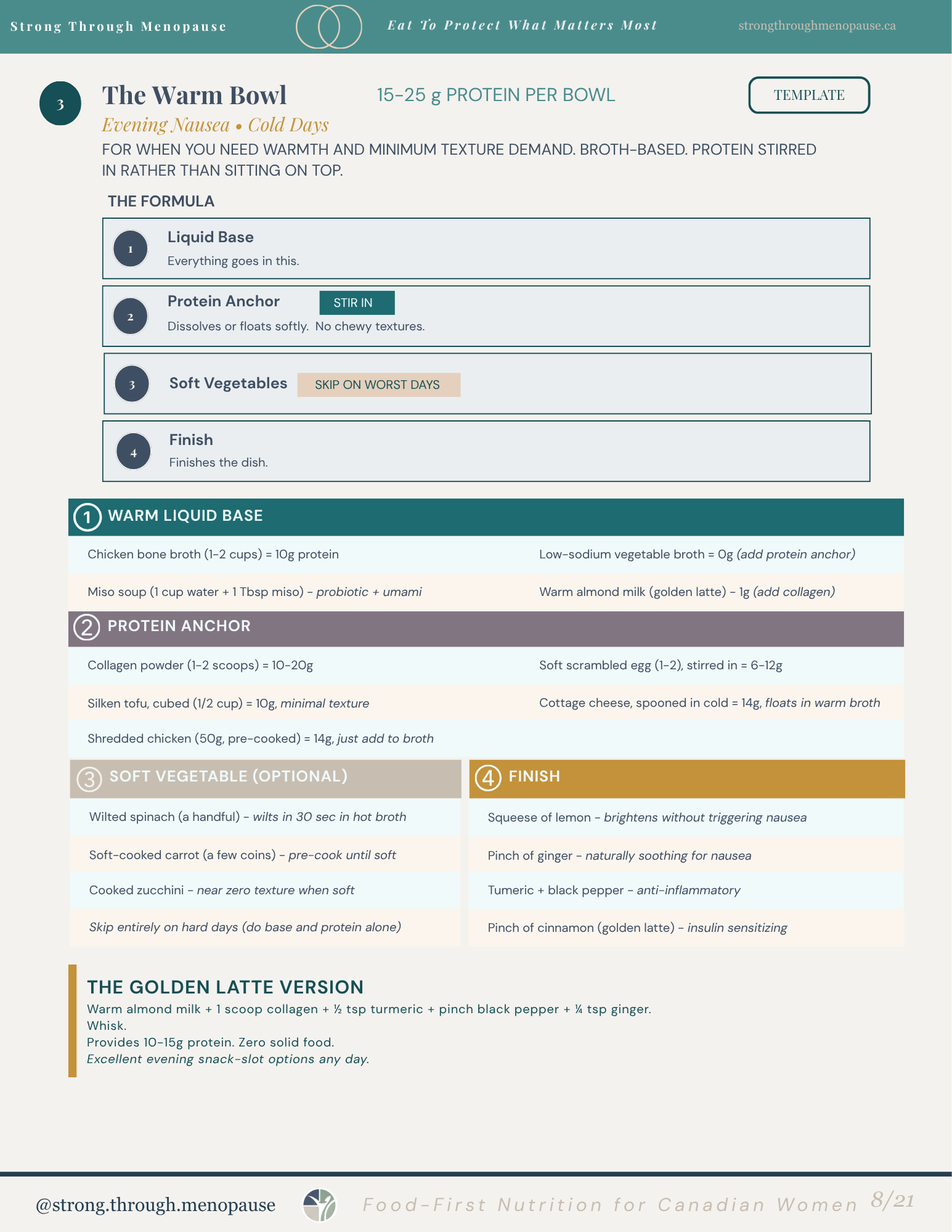 Image 2 of 3
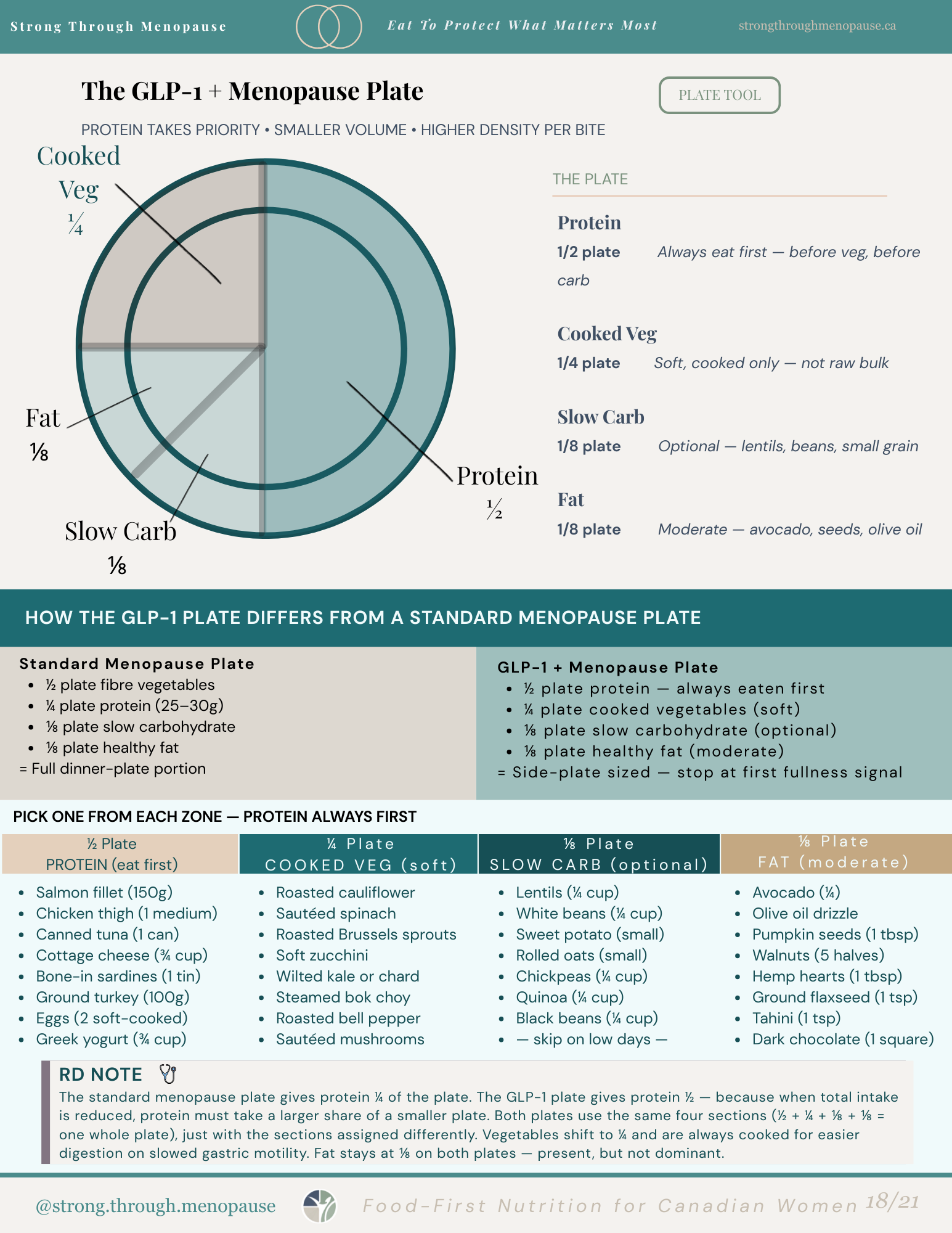 Image 3 of 3
The prescription comes with a dosing schedule and a follow-up date. What it rarely comes with is an answer to the most practical question you have: what do I eat now?
Your appetite has changed. Some days it has nearly disappeared. Eating feels different — smaller, less predictable, sometimes accompanied by nausea that makes the whole question feel impossible. You know you should be eating well. You're not sure what that means anymore on an intake this reduced.
Here is what most women on GLP-1 medications are not told: the weight you're losing is not all fat. A meaningful portion of what these medications drive you to lose can be lean muscle mass. At the same time, estrogen decline through perimenopause and menopause is independently accelerating muscle loss through a completely separate mechanism. The result: you may be losing muscle from two directions at once — while eating less food than you ever have, and therefore less protein than your body needs to protect itself.
This is the nutritional gap that rarely fits in a fifteen-minute prescribing appointment. This guide exists to fill it.
Developed by a Canadian Registered Dietitian with 25 years of clinical experience who is navigating perimenopause herself, this strategy guide is built around one non-negotiable: protecting lean muscle while your body navigates two of the most significant metabolic shifts it will ever experience at the same time. Not recipes. Not rigid meal plans. A flexible eating framework that adapts to how you actually feel on any given day — because GLP-1 eating is not the same from one day to the next.
What's inside:
Five eating templates — fill-in-the-blank formulas built for a suppressed appetite, including the Protein Bowl, the Protein Smoothie, the Warm Bowl, the No-Cook Assembly Plate, and the Protein Sip — each with full options lists and protein counts at every slot
Seven day types showing which templates to combine based on how you're actually feeling — High Protein Day, Nausea Day, Build Day, Gentle Gut Day, Iron & Strength Day, Social Day, and Reset Day
The GLP-1 + Menopause plate tool showing how your plate changes when protein must take priority in a smaller portion — and how it differs from a standard menopause plate
Three printable reference cards: the Nausea Protocol (five foods that almost always stay down, designed for your fridge), Protein by Volume (what 20–30g of protein looks like in a small portion), and Eating Out (how to navigate a restaurant meal with confidence on a GLP-1)
A complete How to Use the Templates guide so the system makes sense before you start
Clinical RD notes throughout explaining the mechanism behind every strategy — not just what to do, but why it matters for your specific situation
A Note from Kari on the nutritional gap this guide was built to address
This guide is for you if:
You are on a GLP-1 medication — semaglutide, tirzepatide, or similar — and in perimenopause or menopause
You have struggled to know what to eat on days when appetite is minimal, nausea is present, or cooking feels like too much
You want to protect your lean muscle mass but don't know how to hit meaningful protein targets on a significantly reduced appetite
Your prescribing appointment covered the medication but not the nutrition — or covered nutrition only as "eat more protein" without a strategy for how
You want clinical eating strategy explained in plain language by an RD who understands both the medication and the menopause transition
You live in Canada and want Canadian food references and grocery sourcing throughout
A note on the evidence: This guide is a nutritional resource designed to complement your GLP-1 medication — not to replace medical supervision. Always work with your prescribing physician regarding medication decisions, dose adjustments, and symptoms you experience. Protein targets in this guide (100g+ daily) are general recommendations; individual needs vary based on body weight, activity level, and kidney function. If you have kidney disease or conditions affecting protein metabolism, consult your healthcare provider before following this guide.
Strategy Guide · GLP-1 Edition · 21 Pages · Food-First Nutrition · Canadian RD Developed
Developed by Kari McKnight, RD · strongthroughmenopause.ca · @strong.through.menopause
Food-First Nutrition for Canadian Women
The prescription comes with a dosing schedule and a follow-up date. What it rarely comes with is an answer to the most practical question you have: what do I eat now?
Your appetite has changed. Some days it has nearly disappeared. Eating feels different — smaller, less predictable, sometimes accompanied by nausea that makes the whole question feel impossible. You know you should be eating well. You're not sure what that means anymore on an intake this reduced.
Here is what most women on GLP-1 medications are not told: the weight you're losing is not all fat. A meaningful portion of what these medications drive you to lose can be lean muscle mass. At the same time, estrogen decline through perimenopause and menopause is independently accelerating muscle loss through a completely separate mechanism. The result: you may be losing muscle from two directions at once — while eating less food than you ever have, and therefore less protein than your body needs to protect itself.
This is the nutritional gap that rarely fits in a fifteen-minute prescribing appointment. This guide exists to fill it.
Developed by a Canadian Registered Dietitian with 25 years of clinical experience who is navigating perimenopause herself, this strategy guide is built around one non-negotiable: protecting lean muscle while your body navigates two of the most significant metabolic shifts it will ever experience at the same time. Not recipes. Not rigid meal plans. A flexible eating framework that adapts to how you actually feel on any given day — because GLP-1 eating is not the same from one day to the next.
What's inside:
Five eating templates — fill-in-the-blank formulas built for a suppressed appetite, including the Protein Bowl, the Protein Smoothie, the Warm Bowl, the No-Cook Assembly Plate, and the Protein Sip — each with full options lists and protein counts at every slot
Seven day types showing which templates to combine based on how you're actually feeling — High Protein Day, Nausea Day, Build Day, Gentle Gut Day, Iron & Strength Day, Social Day, and Reset Day
The GLP-1 + Menopause plate tool showing how your plate changes when protein must take priority in a smaller portion — and how it differs from a standard menopause plate
Three printable reference cards: the Nausea Protocol (five foods that almost always stay down, designed for your fridge), Protein by Volume (what 20–30g of protein looks like in a small portion), and Eating Out (how to navigate a restaurant meal with confidence on a GLP-1)
A complete How to Use the Templates guide so the system makes sense before you start
Clinical RD notes throughout explaining the mechanism behind every strategy — not just what to do, but why it matters for your specific situation
A Note from Kari on the nutritional gap this guide was built to address
This guide is for you if:
You are on a GLP-1 medication — semaglutide, tirzepatide, or similar — and in perimenopause or menopause
You have struggled to know what to eat on days when appetite is minimal, nausea is present, or cooking feels like too much
You want to protect your lean muscle mass but don't know how to hit meaningful protein targets on a significantly reduced appetite
Your prescribing appointment covered the medication but not the nutrition — or covered nutrition only as "eat more protein" without a strategy for how
You want clinical eating strategy explained in plain language by an RD who understands both the medication and the menopause transition
You live in Canada and want Canadian food references and grocery sourcing throughout
A note on the evidence: This guide is a nutritional resource designed to complement your GLP-1 medication — not to replace medical supervision. Always work with your prescribing physician regarding medication decisions, dose adjustments, and symptoms you experience. Protein targets in this guide (100g+ daily) are general recommendations; individual needs vary based on body weight, activity level, and kidney function. If you have kidney disease or conditions affecting protein metabolism, consult your healthcare provider before following this guide.
Strategy Guide · GLP-1 Edition · 21 Pages · Food-First Nutrition · Canadian RD Developed
Developed by Kari McKnight, RD · strongthroughmenopause.ca · @strong.through.menopause
Food-First Nutrition for Canadian Women